Hazrat Masoumeh (s)
Quelle est la raison de la haute position de Hazrat Masoumeh (s) parmi les descendants des imams ? Modèle:Fin de la question
Le sanctuaire de Hazrat Masoumeh (s) Hazrat Masoumeh (s) (173 - 201 AH) est la fille de l'Imam Kazem (as), la sœur de l'Imam Reza (as) et l'une des femmes vertueuses et célèbres parmi les chiites.
Son nom original est Fatemeh, et parmi ses titres célèbres figurent Masoumeh, Karimeh Ahl al-Bayt, Shafie'ah et Taherah. Dans les hadiths, on lui attribue le statut d'intercession, d'infaillibilité et un rang scientifique. L'Imam Reza (as) a considéré la récompense de la visite du tombeau de sa sœur comme étant égale à la récompense de la visite de son propre tombeau. De nombreux savants chiites ont rapporté des récits sur la noblesse et la vertu de Fatemeh Masoumeh (s).
L'un des événements les plus importants de la vie de Fatemeh Masoumeh (s) fut son voyage en Iran pour rencontrer son frère, l'Imam Reza (as). Les livres chiites rapportent que lors de ce voyage, dans la ville de Saveh, leur caravane fut attaquée et plusieurs de ses membres furent tués. Fatemeh Masoumeh (s) tomba malade après cet incident et, après s'être rendue à Qom, elle mourut de sa maladie.
Le tombeau de Fatemeh Masoumeh (s) se trouve dans la ville de Qom. Au début, son tombeau était une simple tombe. Ce tombeau a été développé sous différentes dynasties, en particulier sous les dynasties chiites. Le sommet du développement du sanctuaire de Fatemeh Masoumeh (s) a eu lieu pendant la période safavide et après. Modèle:Portail
Position
Fatemeh Masoumeh (s) est considérée comme l'une des descendantes d'imams les plus vertueuses parmi les chiites.[1] Elle est la fille de l'Imam Moussa Kazem (as), la sœur de l'Imam Reza (as) et la tante de l'Imam Jawad (as). Son sanctuaire à Qom est considéré comme le deuxième sanctuaire d'Ahl al-Bayt (as) en Iran, après le sanctuaire de l'Imam Reza (as) à Mashhad.[2]
Vertu
Fatemeh Masoumeh (s) est considérée comme ayant le statut d'intercession.[3] L'Imam Ja'far Sadegh (as) a considéré l'intercession de Fatemeh Masoumeh (s) comme la cause de l'entrée des chiites au paradis.[4] Certains, se basant sur ce récit, ont considéré l'intercession de Fatemeh Masoumeh (s) comme étant vaste.[5]
Certains, se basant sur une partie de la formule de visite de Fatemeh Masoumeh (s), l'ont considérée comme la fille de l'esprit et du corps du Prophète Mohammad (s), de Hazrat Zahra (s), de Khadijah Kubra (s) et des Imams infaillibles (as).[6] De plus, une autre partie de cette formule de visite prouve le statut d'infaillibilité pour Fatemeh Masoumeh (as).[7]
Les bénédictions et les vertus liées à la terre et à la visite de Son Éminence sont d'autres aspects de la vertu de Fatemeh Masoumeh (s). Dans certains récits, la récompense de la visite de Fatemeh Masoumeh (s) est considérée comme le paradis.[8] De nombreux récits sur la noblesse et la vertu de Hazrat Fatemeh Masoumeh (s) ont été rapportés par des savants chiites.[9] Par exemple, il est rapporté que Mulla Sadra, le philosophe chiite décédé en 1050 AH, se rendait en pèlerinage auprès de Son Éminence et s'y attachait pour résoudre ses problèmes scientifiques et philosophiques.[10] De même, Cheikh Abbas Qomi (1294-1359 AH), un muhaddith et historien chiite, a appelé Fatemeh Masoumeh (s) Sayyidah Jalilah et la plus vertueuse des filles de l'Imam Moussa Kazem (as).[11] De nombreux miracles sont rapportés pour la visite et le sanctuaire de Son Éminence dans les sources.[12] Le zarih de Hazrat Masoumeh (s) et la vue sous le dôme du sanctuaire
Savoir
Fatemeh Masoumeh (s) est considérée comme une femme savante et une narratrice de hadiths.[13] Les muhaddithin chiites et sunnites ont inclus les récits rapportés par Fatemeh Masoumeh dans leurs sources. Parmi ces récits, on peut citer :
1. Mohammad ibn Mohammad Jazari (751-833 AH), muhaddith et faqih shafi'i, rapporte par l'intermédiaire de Fatemeh Masoumeh (s), et elle par l'intermédiaire des filles des imams infaillibles (as), comme Sakineh, fille de l'Imam Hossein (as), et Umm Kulthum, fille de l'Imam Ali (as), de Fatemeh Zahra (s) qu'elle a dit : Modèle:Texte arabe[14]
2. Bakr ibn Ahmad rapporte de Fatemeh, fille de l'Imam Reza (as), et elle de Fatemeh Masoumeh (as), et elle par l'intermédiaire des filles des imams infaillibles (as) de Fatemeh Zahra (s) que le Messager de Dieu (s) disait que le Jour de la Résurrection, tous seront appelés par le nom de leurs mères, sauf les chiites d'Ali ibn Abi Talib (as).[15]
Titres
De nombreux titres sont mentionnés pour Hazrat Masoumeh (s) dans les sources : parmi eux, on peut citer les titres de Taherah (pure), Hamideh (louée), Berreh (bienfaisante), Rashideh (guidée), Taqiyyah (pieuse), Raziyyah (satisfaite de Dieu), Marziyyah (agréée par Dieu), Naqiyyah (pure), Ukht al-Reza (sœur de l'Imam Reza), Sayyidah Siddiqah (dame très véridique), Sayyidah Raziyyah Marziyyah (dame satisfaite de Dieu et agréée par Lui), Muhaddithah (narratrice de hadiths), Abidah (adoratrice) et Sitti (maîtresse).[16]
Masoumeh est un autre titre célèbre de la fille de l'Imam Kazem (as). Ce titre est tiré d'un récit rapporté de l'Imam Reza (as) : Modèle:Texte arabe Bien que le titre Masoumeh n'implique pas l'infaillibilité au même degré que l'infaillibilité des Imams infaillibles (as), il indique qu'elle possède un degré inférieur d'infaillibilité ; un rang qui ne se trouve pas chez les gens ordinaires.[17]
Parmi les autres titres de Hazrat Masoumeh (s) figure Karimeh Ahl al-Bayt. Mar'ashi Najafi (1276-1369 SH), une autorité religieuse chiite, a rapporté que l'Imam Mohammad Baqir (as) ou l'Imam Ja'far Sadegh (as) a dit à son père en rêve : « À toi la Karimeh Ahl al-Bayt. »[18] Shafie'ah est un autre titre de Fatemeh Masoumeh (s). Il est rapporté de l'Imam Sadegh (as) : Modèle:Texte arabe[19]
Biography
Not much information is available about the life of Lady Ma'sumah (S.A.); including her birth and death dates and details of her life.[20] According to some later sources, her birth occurred in the year 173 AH, during the caliphate of Harun al-Rashid, in Medina. Fatimah Ma'sumah lost her father, Imam Kadhim (A.S.), at the age of ten.[21] Fatimah Ma'sumah's (S.A.) father was Imam Musa Kadhim (A.S.), the seventh Imam of the Shi'ites, and her mother, Najmah, was a virtuous lady. Shaykh Saduq narrated that Najmah Khatun was famous for her intellect, wisdom, obedience, worship, and observance of etiquette. Historical sources have explicitly stated that Imam Reza (A.S.) and Lady Ma'sumah (A.S.) shared the same mother.[22]
Lady Ma'sumah (S.A.) never married during her lifetime. Some have cited the reason for her not marrying as not finding a suitable match or someone worthy of her.[23] One of the mentioned possibilities regarding her not marrying is that Imam Kadhim (A.S.) himself advised his daughters not to marry. Opponents of this claim have rejected such a will as being against the tradition of the Prophet (PBUH) and the practice of the Ahl al-Bayt (A.S.). Some have also said that the severe repression during the eras of Harun and Ma'mun al-Abbasi prevented anyone from daring to easily visit the house of Musa ibn Ja'far and become his son-in-law. Furthermore, the imprisonment of Lady Musa ibn Ja'far (A.S.), his martyrdom in prison, Imam Reza's (A.S.) summons to Khorasan, and the Imam's separation from his sisters added to this reason.[24]
Journey to Iran and Demise
The author of the History of Qom states that in the year 200 AH, Ma'mun, the Abbasid Caliph, summoned Imam Reza (A.S.) from Medina to Marv to be his crown prince. The Imam's sister, Fatimah Ma'sumah (S.A.), set out for Iran in 201 AH with the intention of visiting her brother. It is said that Lady Fatimah Ma'sumah (S.A.) had prepared for the journey after receiving her brother's letter.[25]
Fatimah Ma'sumah (S.A.) traveled towards Tus in Iran in 201 AH. On this journey, five of Fatimah Ma'sumah's (S.A.) brothers, namely Fadl, Ja'far, Hadi, Qasim, and Zayd, along with some of her nephews and a few servants, accompanied her. According to some, Fatimah Ma'sumah (S.A.) traveled with 23 of her brothers and nephews. Others have said that Lady Ma'sumah (S.A.) was accompanied by only one servant on this journey.[26] Fatimah Ma'sumah (A.S.) endured the hardship of this long journey until she reached the city of Saveh. The people of that city, who were enemies of the Ahl al-Bayt (A.S.) at that time, attacked her caravan. A fierce battle ensued, and all of her brothers and nephews were martyred. The grief of the martyrdom of 23 relatives eventually led Fatimah Ma'sumah to her sickbed. The people and nobles of Qom, who were lovers of the Prophet's family (PBUH), upon learning of this incident, went to Saveh and, after meeting Fatimah Ma'sumah (S.A.), took her to Qom at her request. Fatimah Ma'sumah stayed for seventeen days in the house of one of the elders of Qom, named Musa ibn Khazraj Ash'ari, while she was ill. Finally, Fatimah Ma'sumah (S.A.) passed away on the tenth of Rabi' al-Thani in the year 201 AH in the city of Qom.[27]
The exact date of Fatimah Ma'sumah's (S.A.) demise is not mentioned in early sources; however, later sources state her death anniversary as the tenth of Rabi' al-Thani in the year 201 AH, at the age of 28. Some have also recorded the twelfth of Rabi' al-Thani. Some researchers believe that both dates are estimates.[28] According to another report, after that attack in Saveh, the enemies poisoned Fatimah Ma'sumah's (S.A.) food, and that poison caused her illness and ultimately her martyrdom after seventeen days.[29]
Some have said that given the military conflict with Fatimah Ma'sumah's (S.A.) caravan, her martyrdom was probable; because her illness was influenced by this war. The report in the History of Qom, regarding Fatimah Ma'sumah's (S.A.) demise due to illness, can be interpreted as the conservative stance of the dominant Ash'aris who tried to maintain their relationship with the Abbasid government. The author of the History of Qom was one of the Ash'aris.[30]
Pilgrimage Prayer and Reward of Pilgrimage
Modèle:Main article The pilgrimage to Lady Masoumeh holds a special status in the words of the Ahl al-Bayt, and narrations have been issued regarding its importance. These narrations speak of the reward for her pilgrimage.[31]
- Sa'd ibn Sa'd asked Imam Reza (AS) about the pilgrimage of Fatimah, daughter of Musa? The Imam said: Modèle:Arabic text[32] [33]
- Imam Jawad (AS) said concerning the virtue of visiting the grave of his aunt: Modèle:Arabic text[34]
Pilgrimage Prayer
Allamah Majlisi in his book Bihar al-Anwar and some other works has narrated a pilgrimage prayer for Lady Masoumeh.[35] which is recited today beside her shrine.
This pilgrimage prayer begins with divine invocations. First, near the grave and facing the Qibla, one should recite "Allahu Akbar" 34 times, "Subhanallah" 33 times, and "Alhamdulillah" 33 times, and then the text of the pilgrimage prayer is recited.[36]
Shrine
According to historical sources, Fatimah Masoumeh (SA) was buried in the Baghe Babilan neighborhood of Qom.[37] Initially, a mat was placed over her grave.[38] After that, the shrine of Lady Masoumeh (SA) underwent many changes and developments throughout history and expanded in different periods.[39] The construction of the sanctuary of Fatimah Masoumeh (SA) began in the mid-3rd century AH, and throughout the 4th to 6th centuries, it had a dome and cupola with decorations.[40] However, before the Safavid era, there was no magnificent zarih (enclosure) or iwan (portico) for the shrine.[41]
During the Safavid period, the shrine was expanded, including the construction of the Atiq Courtyard and the Golden Iwan.[42] The expansion of the shrine continued during the Qajar period. Fath-Ali Shah Qajar paved the floor of the shrine with marble. According to the inscription in the shrine, the mirror work on the walls of the shrine also began during the time of Fath-Ali Shah and was completed during the reign of Mohammad Shah.[42] During the reign of Naser al-Din Shah Qajar, the Atabak Courtyard was also built.[43] After the Islamic Revolution of Iran, the shrine was also expanded, and sections such as the Imam Khomeini Shabestan (prayer hall) were added to the shrine.[44]
After the Islamic Revolution of Iran, the shrine was also expanded, and sections such as the Imam Khomeini Shabestan (prayer hall) were added to the shrine.[44]Courtyards and Porticos
The Holy Shrine of Lady Masoumeh (SA) has several courtyards:
- The Atiq Courtyard, which is called the Small Courtyard, the Old Courtyard, and today the Imam Hadi (AS) Courtyard. This courtyard is square-shaped and has three iwans. The Golden Iwan is located in this courtyard.[45]
- The Atabaki Courtyard, which is called the New Courtyard and today the Imam Reza (AS) Courtyard. This courtyard was built during the reign of Naser al-Din Shah Qajar by Mirza Ali Asghar Khan Atabak. The Mirror Portico, which was built in 1130 AH by the order of Ali Akbar Khan Atabak, is located in this courtyard.[46]
- The Saheb al-Zaman (AS) Courtyard, which has an area of about 8000 square meters and has four entrances. This courtyard is located next to the Imam Khomeini Shabestan.[44]
- The Jawad al-A'immah (AS) Courtyard; this courtyard, which has an area of over 15000 square meters, was built over the Qomrud River. This courtyard, with four main entrances and two emergency entrances, was built in the late 2000s.[47]
- The Prophet Azam (PBUH) Courtyard; the construction of this courtyard began in the late 2000s.[48]
There are six porticos in the Holy Shrine of Lady Masoumeh (SA), most of which have a smaller dome than the main dome of the shrine. Three porticos were built by the Safavids, two by the Qajars, and one belongs to the contemporary era.[49]
Zarih (Enclosure)
The first zarih of the tomb of Lady Masoumeh (SA) was built by Shah Tahmasp I. Shah Tahmasp later installed another zarih made of white and transparent steel around the previous one. This zarih was replaced in 1000 AH by Shah Abbas I Safavid with another zarih. Fath-Ali Shah Qajar covered this zarih with silver plates in 1245 AH and placed it on a marble base. After several restorations, its shape was finally changed in 1348 SH, and its height was increased.[50] In 2001 SH, the zarih of Lady Masoumeh (SA) underwent a complete renovation.[51]
Dome
The first dome over the tomb of Lady Masoumeh was built by a woman named Zaynab,[52] whom some have identified as the daughter of Imam Jawad (AS).[53] "Amir Abul-Fazl Iraqi", the ruler of Qom during the Seljuk period, built a new dome.[54] In 925 AH, Shah Begum Safavi demolished this dome and built another one, which remains today. This dome was decorated with 12,000 golden bricks in 1518 AH by the order of Fath-Ali Shah. The height of this dome from the roof of the shrine is 16 meters and from the ground is 32 meters.[55] The dome was renovated in the 2000s during the Islamic Republic era.[56]
Minarets
- Two minarets exist in the Atabaki Courtyard, which are among the tallest structures of the shrine and are located above the Mirror Iwan.
- Two minarets are located on the other side of the Atabaki Courtyard, opposite the Mirror Iwan.
- Two minarets were built in the Golden Iwan in the Atiq Courtyard, covered with spiral knot tiles.[57]
Gallery
-
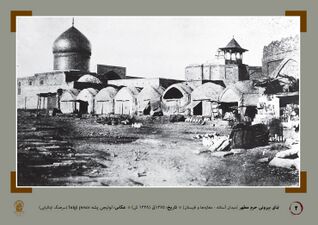 Exterior view of the Holy Shrine of Fatimah Ma'sumah (S.A.) from Astaneh Square (1859 CE).
 -
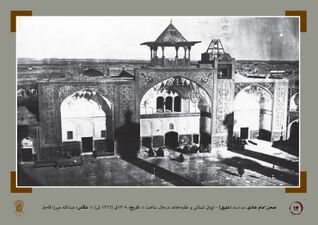 Atiq Courtyard and Naqqareh Khaneh (1887 CE).
 -
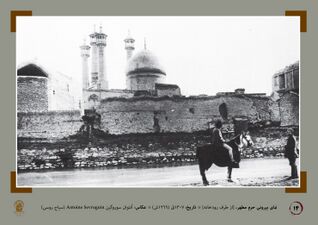 Exterior view of the Holy Shrine of Fatimah Ma'sumah (S.A.) from Qom River and high walls built to prevent flood entry into the shrine (1890 CE).
 -
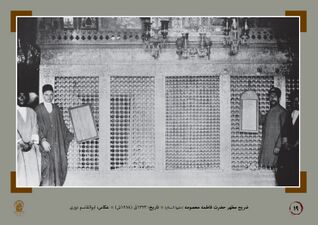 Zarih (reliquary) of the tomb of Fatimah Ma'sumah (S.A.) (1905 CE).
 -
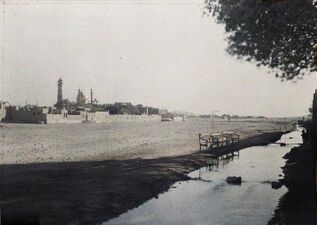 Panoramic view of the Holy Shrine of Fatimah Ma'sumah (S.A.) (1927 CE).
 -
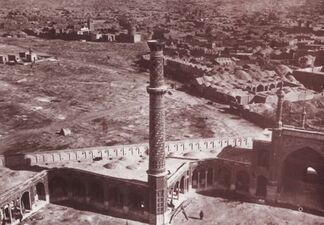 A view of a part of Atabaki Courtyard.
 -
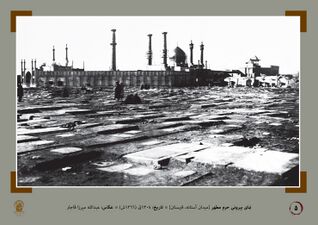 Exterior view of the Holy Shrine of Fatimah Ma'sumah from Astaneh Square (1887 CE).
 -
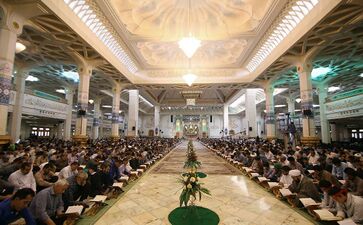 Collective Quran recitation in Imam Khomeini Shabestan of the Holy Shrine of Fatimah Ma'sumah (S.A.).
 -
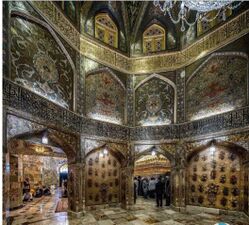 A view of one of the porticos of the Holy Shrine of Fatimah Ma'sumah (S.A.).
 -
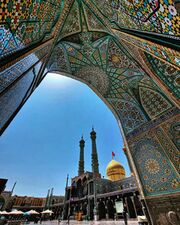 A view of the dome and minarets of Atabaki Courtyard of the Holy Shrine of Fatimah Ma'sumah (S.A.).


References
- ↑ Qomi, Abbas ibn Mohammad Reza, Montaha al-Amal fi Tarikh al-Nabi wa al-Al, Qom, Daftar Nashr Islami, vol. 2, p. 378.
- ↑ Eshaqi, Seyyed Hossein, Mahtab Ahl al-Bayt (Un aperçu de la vie de Karimeh Ahl al-Bayt Hazrat Masoumeh), Qom, Markaz Pazhouheshha-ye Islami Seda va Sima, 1386 SH, p. 3-6.
- ↑ Mohammadi Eshtehardi, Mohammad, Hazrat Masoumeh (s) Fatemeh Doum, Qom, Nashr Akhlaq, 1380, p. 178-179.
- ↑ Al-Majlisi, Bihar al-Anwar al-Jami'ah li Durar al-Akhbar al-A'immah, Beyrouth, Dar Ihya al-Turath al-Arabi, 1403 AH, vol. 57, p. 228.
- ↑ Mohammadi Eshtehardi, Hazrat Masoumeh (s) Fatemeh Doum, p. 178-179.
- ↑ Mohammadi Eshtehardi, Mohammad, « Hazrat Masoumeh (s), Akhtar Tabban Al Mohammad (s) », Nashriyeh Pasdar Islam, n° 177, 1357.
- ↑ Mohammadi Eshtehardi, Hazrat Masoumeh (s) Fatemeh Doum, p. 159.
- ↑ Ibn Qulawayh, Ja'far ibn Mohammad, Kamil al-Ziyarat, Tahqiq Abd al-Hossein Amini, Najaf, Dar al-Murtadawiyah, p. 324.
- ↑ Pour des exemples, voir : Mohammadi Eshtehardi, Mohammad, « Hazrat Masoumeh (s), Akhtar Tabban Al Mohammad (s) ».
- ↑ Qomi, Abbas ibn Mohammad Reza, Al-Fawa'id al-Razawiyah fi Ahwal Ulama al-Madhab al-Ja'fariyah, Tahqiq Nasser Baqeri Bidehendi, Qom, Boostan Ketab, 1385, p. 618.
- ↑ Qomi, Montaha al-Amal, vol. 2, p. 378 ; aussi : Qomi, Abbas ibn Mohammad Reza, Mafatih al-Janan, Qom, Entesharat Osweh, sans date, p. 562.
- ↑ Pour des informations détaillées, voir : Mohammadi Eshtehardi, Hazrat Masoumeh (s) Fatemeh Doum, p. 191-219.
- ↑ Sadeghi Ardestani, Ahmad, Zanan Daneshman va Rawi Hadith, Qom, Markaz Entesharat Daftar Tablighat Islami, 1377, p. 350-351.
- ↑ Ibn al-Jazari, Mohammad ibn Mohammad, Asna al-Matalib fi Manaqib al-Imam Ali (as), Ispahan, Maktabat al-Imam Amir al-Mu'minin Ali (as) al-Ammah, p. 50-51.
- ↑ Al-Qomi, Abbas ibn Mohammad Reza, Safinat al-Bihar wa Madinat al-Hikam wa al-Athar, Téhéran, Dar al-Osrah li al-Tiba'ah wa al-Nashr, 1392, vol. 4, p. 545.
- ↑ Na'ini Ardestani, Mohammad Ali ibn Hossein, Anwar al-Mosh'ashe'in, Tahqiq Mohammad Reza Ansari Qomi, Qom, Ketabkhaneh Bozorg Hazrat Ayatollah al-Ozma Mar'ashi Najafi, vol. 1, p. 211 ; aussi : Rafiei, Ali, Tarikh Zendegani Imam Kazem (as), Téhéran, Sepah Pasdaran Enghelab Islami, Namayandegi Vali Faqih, Edareh Amoozeshha-ye Aqidati Siyasi, p. 21.
- ↑ Rafiei, Tarikh Zendegani Imam Kazem (as), p. 21.
- ↑ Rafiei, Tarikh Zendegani Imam Kazem (as), p. 21.
- ↑ Rafiei, Tarikh Zendegani Imam Kazem (as), p. 21.
- ↑ Mahallati, Riyāḥīn al-Sharīʿah, vol. 5, p. 31.
- ↑ From Birth to Death, Comprehensive Portal of the Holy Shrine of Lady Fatimah Ma'sumah (S.A.), Date of publication: 1398, Date of visit: 1401.
- ↑ A group of writers, Encyclopedia of Imam Kadhim (A.S.), no place, Ashura Specialized Website, no date, p. 338.
- ↑ Elhami, Davood, A Journey Through the History of Shi'ism, Qom, Maktab Islam, 1375, p. 545.
- ↑ Hosseini, Seyyed Javad, "The Secret of Lady Ma'sumah's (S.A.) Unmarried Status," Farhang Kowsar, 1386, no. 69.
- ↑ Faghihi, Ali-Asghar, Religious History of Qom, Qom, Zaer Publications, 1387, p. 92.
- ↑ From Birth to Death, Comprehensive Portal of the Holy Shrine of Lady Fatimah Ma'sumah (S.A.), Date of publication: 1398, Date of visit: 1401.
- ↑ Rafiei, History of the Life of Imam Kadhim (A.S.), pp. 24-25.
- ↑ 23 Rabi' al-Awwal, the anniversary of the arrival of Lady Fatimah Ma'sumah (S.A.), Library of Fiqh School, Date of publication: 1396, Date of visit: 1401.
- ↑ Tashid, Ali-Akbar, Hadyah-ye Isma'il or the Uprising of the Alawi Sayyids for the Caliphate, Tehran, Dar al-Kutub al-Islamiyyah, 1385 SH, p. 166.
- ↑ Pak, Mohammad Reza, "Qom in the First Two Centuries of Hijra," History of Islam, Islamic Propagation Office of Qom Seminary, 1382, no. 14, p. 10.
- ↑ Modèle:Journal citation
- ↑ Ibn Qulawayh, Ja'far ibn Muhammad, Kamil al-Ziyarat, Najaf Ashraf, Dar al-Murtadawiyyah, first edition, 1356 AH, Chapter 106, p. 324, Hadith 1.
- ↑ Ibn Babawayh, Muhammad ibn Ali, Uyun Akhbar al-Reza (AS), Tehran, Nashr Jahan, first edition, 1378 AH, Chapter 67, vol. 2, p. 267, Hadith 1.
- ↑ Ibn Qulawayh, Ja'far ibn Muhammad, Kamil al-Ziyarat, Najaf Ashraf, Dar al-Murtadawiyyah, first edition, 1356 AH, Chapter 106, p. 324, Hadith 2.
- ↑ Al-Majlisi, Bihar al-Anwar, vol. 99, pp. 266-267; also: Al-Majlisi, Muhammad Baqir, Tuhfat al-Za'ir, Qom, Imam Hadi (AS) Institute, 1386 AH, p. 4; also: Al-Majlisi, Zad al-Ma'ad, Beirut, Mu'assasat A'lami lil-Matbu'at, 1423 AH, pp. 548-547.
- ↑ Al-Majlisi, Bihar al-Anwar, vol. 99, pp. 266-267.
- ↑ Kiani, Yousef, "The Complex of the Holy Shrine of Lady Masoumeh (SA)", Faculty of Literature and Humanities, University of Tehran, No. 151, Autumn 1999, p. 64.
- ↑ Sajjadi, Sadegh, "The Shrine of Lady Masoumeh", Great Islamic Encyclopedia, Tehran, Center for the Great Islamic Encyclopedia, vol. 1, p. 360.
- ↑ Sajjadi, "The Shrine of Lady Masoumeh", Great Islamic Encyclopedia, vol. 1, pp. 358-362.
- ↑ Sotoudeh, Manouchehr, Books of the Holy Shrine of Lady Masoumeh (SA) and its surrounding courtyards, Qom, Library of Grand Ayatollah Mar'ashi Najafi, 1375 AH, p. 19.
- ↑ Rezaei Nodushan, "The Evolution of the Shrine of Lady Masoumeh (SA)", Iranian Architectural Studies, p. 92.
- ↑ 42,0 et 42,1 Sajjadi, "The Shrine of Lady Masoumeh", Great Islamic Encyclopedia, vol. 1, p. 359.
- ↑ Vazin Afzal, Mehdi, "The Expansion of the Shrine of Lady Masoumeh and the Increase of Pilgrims to Qom during Naser al-Din Shah's Era", Research in History, Second Year, No. 3, Autumn 2011, p. 65.
- ↑ 44,0 44,1 et 44,2 "Holy Shrine of Lady Masoumeh", Reisen Iran website, date of article: June 3, 2022, date of visit: January 4, 2023.
- ↑ Sajjadi, "The Shrine of Lady Masoumeh", Great Islamic Encyclopedia, vol. 1, p. 360.
- ↑ Sajjadi, "The Shrine of Lady Masoumeh", Great Islamic Encyclopedia, vol. 1, pp. 360-361.
- ↑ "Holy Shrine of Lady Masoumeh" Reisen Iran website.
- ↑ "Holy Shrine of Lady Masoumeh" Reisen Iran website.
- ↑ Sajjadi, "The Shrine of Lady Masoumeh", Great Islamic Encyclopedia, vol. 1, pp. 360-361.
- ↑ Sajjadi, "The Shrine of Lady Masoumeh", Great Islamic Encyclopedia, vol. 1, pp. 359-360.
- ↑ "Historical overview of the holy zarih of Lady Masoumeh (SA) from beginning to present", ISNA, date of article: August 10, 2016, date of visit: January 1, 2023.
- ↑ Sajjadi, "The Shrine of Lady Masoumeh", Center for the Great Islamic Encyclopedia, vol. 1, p. 360.
- ↑ Nodushan, Mohammad Rezaei, "The Evolution of the Shrine of Lady Masoumeh (SA)", Iranian Architectural Studies, No. 16, Autumn and Winter 2019, p. 92.
- ↑ ""The Holy Shrine of Lady Masoumeh (AS) (Qom)", Islamic Teachings (Endowments Organization), No. 29, September 1978, p. 56.
- ↑ Sajjadi, "The Shrine of Lady Masoumeh", Great Islamic Encyclopedia, vol. 1, p. 360.
- ↑ Faqih Mirzayi, Hossein, "Renovation plan of the holy dome of Lady Fatimah Masoumeh (SA)", Hawzah Information Base, date of article: April 21, 2003, date of visit: January 3, 2023.
- ↑ "History of the Holy Shrine of Lady Masoumeh (SA)", Hawzah Information Base, date of article: July 15, 2018, date of visit: January 1, 2023.